Tuesday, June 18, 2013

Climate Finance: some key resources

Anyone pondering the clear family resemblance between carbon trading and high finance is probably, unless they actually have a background in finance, totally confused.  I know I am.  What exactly is a swap?  A future?  Why is the Black-Scholes equation the foundation of an entirely novel economy in which the very nature of value is under question?  I'll point you to two great resources: one just published and one from 2009.

What's clear is that the evolution of carbon markets (and potentially ecosystem service markets) is an extension of the development of novel financial products since the 1980s which led to much higher trade volumes in derivatives than in the actual underlying physical commodities.  Since the financial world learned how to create commodities in risk separate from the thing experiencing the risk (that is, a mortgage is now a different commodity than the risk of a default on that mortgage), the environment has been increasingly parsed out into tranches of essentially unknowable risk and unquantifiable underlyings.  Oscar Reyes at the Climate Finance and Markets site had produced a new reader to guide us through the financial jungle -- he was kind enough to include a piece of mine that originally appeared on EcosystemMarketplace.com.

Of course, everything that comes out of The Corner House is golden, mainly for the accessibility and clarity of its arguments.  See here for their incredibly useful and crystal-clear explanation of the concept and politics behind the term "overpopulation".  On carbon and finance, they have a report out from 2009 which carefully and clearly connects the dots between carbon markets and financial markets, and which should be required reading for all carbon enthusiasts and skeptics alike.  My only nit to pick is the unnecessarily polemical title, but the subtitle, "Learning about Climate Policy from the Financial Crisis," works just fine.  Larry Lohmann and the rest of The Corner House writers are always worth following.


Monday, June 17, 2013

WQT on its tenth or eleventh life?

Don't look now, but WQT is generating some positive bi-partisan buzz on capital hill, with strange bedfellows Cardin (D-MD), Boozman (R-AR) and Vitter (R-LA) saying nice things about it.  The fact that this is essentially cap-and-trade for water pollution is conveniently elided by Vitter, who prefers to blame EPA for implementation problems so far.

It's an EENews report, which is behind a paywall, but Vitter says "This is a pretty new idea, you know, it could offer some potential and benefits," which (a) ignores the nearly 3-decade history of efforts toward the widespread adoption WQT, but (b) has got to feel good for the people at EPRI's Ohio River Basin pilot WQT program.

The obstacles remain, of course: measurement issues, problems defining the credit with scientific approval, problems transferring liability away from the permitee.  But for a policy which has been so long been the poor cousin of wetland banking and carbon trading, any high-level attention is notable.

Timelines and Time-outs

This Clean Water Act Timeline does a far better-than-average job of covering the grainy details of certain key moments over the past 40 years of CWA jurisprudence and policy.  Big props to Rose Ellen O'Connor for putting it together.  It dives into Callaway, Avoyelles, Tulloch, Rapanos and the rest of the rogues gallery of litigants that have shaped the current regulatory program.

The only thing missing are hotlinks to the opinions and regulations themselves, which is of course precisely what will be available on the Clean Water Act Regulatory Timeline (CWART) that will debut on my research site later this year!

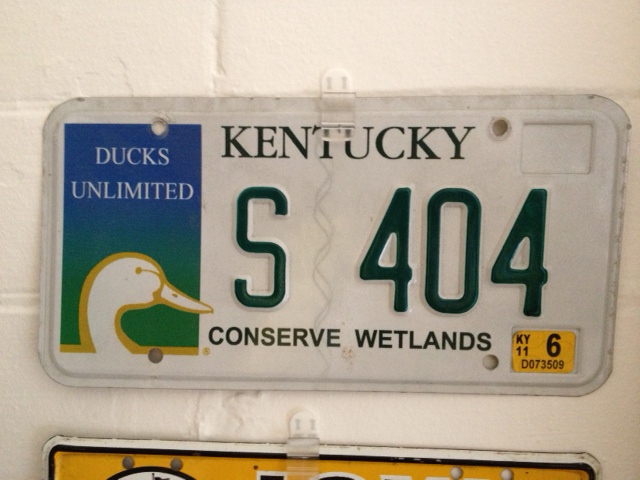
This and much more will be possible from my new perch at the Geography Department at the University of Wisconsin - Madison.  I've had to give up my fancy Kentucky plates, but the density of the wetland landscape here, and the intensity of the policy debate, more than makes up for it.  Watch this space for a return to the commentary on ecosystem services and wetland regulatory policy that I had to set aside during my turbulent mid-year move to Wisconsin and subsequent first-semester acclimatization and course development marathon.  Apologies for the time-out!

Farewell, Kentucky!

Thursday, November 15, 2012

Publication Alert

Fresh off the presses from Progress in Human Geography, a paper I wrote with Jessica Dempsey of the University of Victoria entitled Ecosystem Services: Tensions, Impurities, and Points of Engagement within Neoliberalism.

The nutshell is that ecosystem services, both as economic theory and as policy, has plenty of very interesting internal fault lines and inconsistencies that make it a flexible and adaptive concept whose destination is unknown.  It hardly resembles the cartoon, straightjacketed by market logic, that is often straw-manned by both critics and advocates of market-based policy.

Ok, it's not 50 Shades of Grey, but we do what we can.


Friday, November 9, 2012

Wetlands Carbon: A new methodology

Heads up: American Carbon Registry came out in October with a methodology for defining carbon credits in wetland restoration sites along the Gulf coast.  As they note, deductions for methane will be important and perhaps significant -- it will be very interesting to see how many credits this methodology defines, and whether the market believes in it.

Edit: And a new one here for coastal wetland restoration under the Voluntary Carbon Standard.


Tuesday, November 6, 2012

Can we get a U MAD BRO?

My friend Becca Madsen at Madsen Environmental has done great work in advancing the merger of the rather nerdy if not actually straightlaced world of ecosystem services policy with the meme-driven communicative style of the modern internet.

I am of course in favor of this (as should be clear from my earlier posts), because something, ANYthing, is good if it helps us break through the wall that separates normal, everyday speech from policy talk.  And if it's not said with kittens or bad grammar -- does it really count as speech anymore?
Kids these days.


Wednesday, October 24, 2012

Ten Habits of Highly Effective Federal CWA Regulators

I recently had an experience that reminded me of what a distinct and awesome group of people environmental regulators are, and how hard their job is in coordinating between science, stakeholders and blackletter law.  They do have their share of quirks, which I came to admire (and adopt) over my time at EPA.  I scrawled this list some time ago -- it doesn't really refer to any particular people, but some of you may see yourselves reflected... I certainly do.

10. All flora and fauna present at an impact or compensation site are "critters".

9. No matter how much the Corps/EPA/NMFS/USDA/FWS pisses you off, when push comes to shove they are "our sister agency".

8. Every Corps district staffer has the innate right to complain about how long it took to train in the last District Commander.

7. Every EPA regional staffer has the innate right to complain about the lawyers and politicos up at Headquarters.

6. HQ staff get tiny little crushes on field staff who write extremely well-researched comment letters.

5. Corps and EPA would feel secretly neglected if USDA and FHWA stopped trying to tell them how to administer the permit program.

4. Sure, they'd LOVE to handle that HQ data-call/process-mapping initiative/state assumption proposal.  Not.

3. What we say: "Your agency needs better monitoring and reporting protocols on your conservation grant projects."
What we mean: "I'm just jealous at the size of your grants budget."  

2. Everyone has a story about the time they did wetland delineations [in 2 feet of snow/in the century's worst drought/while being attacked by a doberman] and what they have found in wetlands [a '57 Plymouth/4,000 golf balls/Jimmy Hoffa].

1. A Corps PM, an EPA staff scientist, and an NRCS project officer walk into a bar, and the bartender pours each of them a shot of 30 year-old scotch.  The Corps PM says "that looks isolated and non-jurisdictional", and drains it.  The NRCS staffer says "this was converted from grain prior to December 23, 1985", and drains it.  The EPA staffer
         a) says "We need additional monitoring data -- pour me three more."
         b) says "I have to assess the physical, chemical and biotic integrity of this resource," and -- takes it back to the lab for analysis.
         c) slaps a (c) veto on the bottle and makes off with it.